
Have you ever noticed that sometimes when people are trying to come up with an idea (be it prose, arithmetic, or a drawing), they’ll write it with a pencil and paper first? It’s because they know they’re still in the drafting phase and that it will likely change or they may discard it and start over. When they get closer to the final version, they may use a pen and write on higher quality paper.
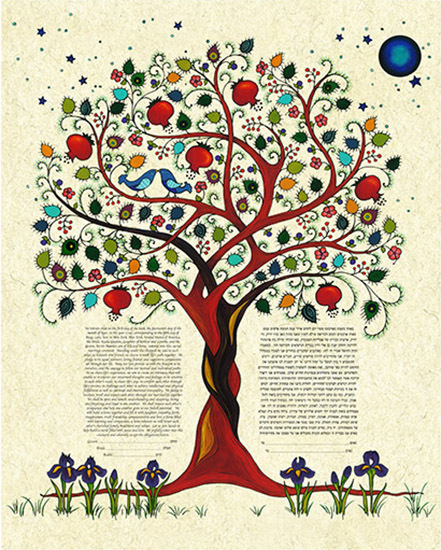
The more important something is, the more people personalize it and use more durable materials (e.g. the paper used for books is different than regular notebook paper). Wedding invitations are sometimes done in calligraphy on special paper, but the date and time can still change. Anyone who planned a wedding after March of 2020 can attest to that.
However, a wedding contract or ketubah, is unlikely to change after the marriage has taken place unless there is a divorce. And therefore, it’s not something that’s typically written in pencil. You wouldn’t want your spouse to arbitrarily go back and make changes to it without your consent.
How would you capture a really important and binding contract, something you don’t want erased or changed? You could have it engraved if it’s short. If you wanted to personalize it, you could write in your own handwriting, thus providing proof that you wrote it.
Did you know that Kings of Israel were required to write out a copy of the Torah in their own handwriting? (Deut. 17:18)
So, when The Most High writes what is basically His ketubah (marriage contract) with the Children of Israel (His bride) in stone with His own finger, it’s evident He did not want the words to be changed by anyone, not even to “honor” Him or His son.
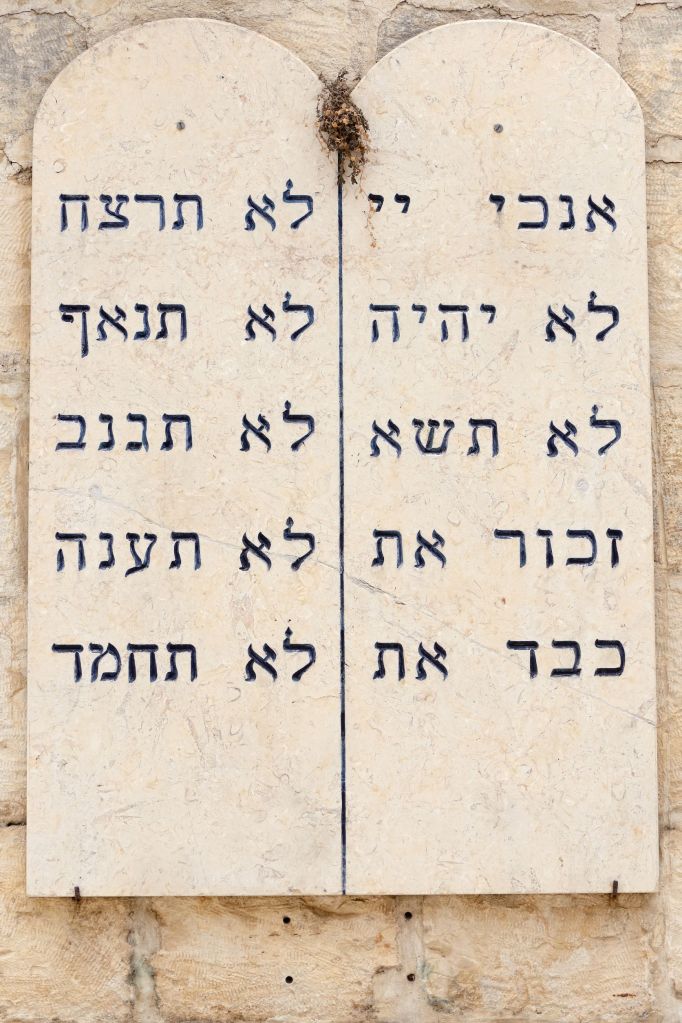
But yet, many people blindly accept the notion that the first century apostles and followers of the Jewish Messiah did exactly that—they started breaking the fourth commandment to honor the Messiah. And if they did it (or at least someone convinces you they did it), then it must be okay. Did your parents ever lecture you about blindly following your friends? Yeshua said:
“Every plant that my heavenly Father has not planted will be pulled up by the roots. Leave them; they are blind guides.[a] If the blind lead the blind, both will fall into a pit.” – Matthew 15:13-14
Am I calling the disciples of Yeshua and the Apostle Paul blind guides? No. But if you automatically accept someone else’s explanation or interpretation of scripture and you:
- Never use a concordance and tools to study the original text (Greek or Hebrew),
- Don’t investigate the scriptures that people used to justify breaking the fourth commandment,
- Ignore the historical and political context of a state-adopted religion
- Ignore the culture of the early pagan converts who were being courted and the culture of the Jews who were being persecuted
Then you are spiritually impaired.
If the Most High writes something on stone with His finger, who are people to erase and then re-write something He wrote? Think about that. Really think about that. And then go back and study the scriptures for yourself.
I think anyone who’s attended a religious service, a funeral or even a conference has heard a speaker go over his or her allotted time. If you grew up in certain Christian denominations, you may have spent all day in church, gone home to eat dinner and then come back. Just because the Apostle Paul often taught and preached on Saturday evening after the Sabbath ended (technically referred to as the first day of the week in Jewish culture) and into the wee hours of the night, that does not mean that he did not keep the Sabbath. It’s a GALACTIC leap to make that claim.

Furthermore, the gospels say that Mary and Martha visited Yeshua’s tomb on Sunday morning and that it was empty. Nowhere in the bible does it say that Yeshua rose from the dead on Sunday morning. It could have happened Saturday evening before sunset (seventh day) or right after sunset (first day) or sometime before midnight (first day). The point is that we don’t actually know on what day Yeshua was resurrected. We only know what day it was that someone observed that his tomb was empty.
What’s the optical Rx for spiritual impairment? The bible also exhorts the followers of the Messiah to:
- Be Bereans and “[search] the Scriptures daily” – Acts 17:11
- “Study to show [yourself] approved” — 2 Timothy 2:15
- “Rightly [divide] the word of truth” — 2 Timothy 2:15
Many followers of the Jewish Messiah have blindly followed and still follow the politically-inspired, anti-Semitic teachings of converted Pagan “bible authorities.” Many continue to follow lazy, blind or spineless theologians who followed them by upholding the transgression of G-d’s law and reinforcing this false teaching.

If someone with a fancy degree from a seminary could find scriptures to convince you that it’s okay to worship a graven image or commit adultery would you believe them? Why is it okay to break some of the “Ten Commandments” but not others? If God told you to do something a certain way, why would you not believe him? Why would you listen to someone else who contradicts or distorts what God told you? Have you learned nothing from Eve and the Serpent?

 Penned By Jen